Many believe brokers are frustrated with the MLS, providing anecdotal evidence that the cooperative marketplace is starting to break down.
The results of the Semi-Annual WAV Group 2026 Broker Sentiment Survey tells a different story. Brokers are not looking to tear down the MLS. They like it. They want it to work better, cover more territory, operate more consistently, and stay focused on the work brokers need it to do most.
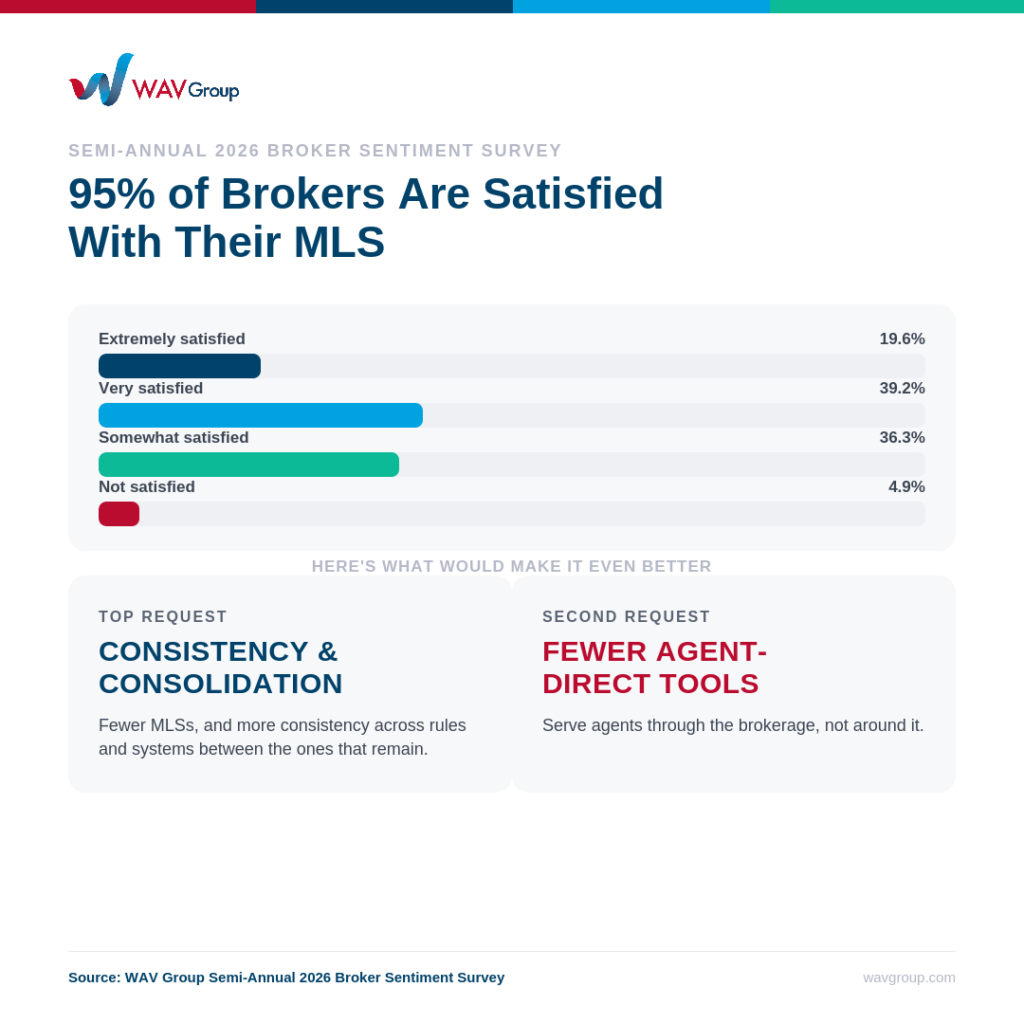
Only 5% are dissatisfied with their MLS and 59% are very/extremely satisfied with their MLS. Approximately 95 out of every 100 brokers surveyed have at least somewhat satisfied satisfaction with the MLS they use every day.
That is a strong endorsement at a time when almost every long-standing industry institution is being questioned. Brokers believe in the value of the cooperative marketplace. They appreciate the access to listing inventory, the ability to cooperate with competitors, and the infrastructure that helps them serve buyers and sellers every day. Their frustration is not with the MLS model itself. It is with the fragmentation, duplication, and complexity that have built up around it.

Brokers Want More Consistency and Fewer Artificial Boundaries
Brokers want fewer MLSs and much more consistency among the ones that remain. Today 42% of practitioners surveyed via the WAV Group Customer Experience Index survey subscribe to more than one MLS and, in some markets, market overlap is as much as 90%.
Brokers operating near market boundaries are tired of managing different rules, different listing input requirements, different forms, and different systems for what is essentially the same business. Their clients do not understand why an agent has to join multiple organizations or use multiple platforms simply because a home happens to be located across a county line or on the other side of an old association boundary.
“Consistency across all MLSs such as input, rules, etc.,” was how one broker described the need. Another asked for “larger coverage, fewer MLSs” and more consistency with neighboring MLSs. Another broker said “More consolidation and lower fees. Statewide MLS instead of having to be a member of and manage multiple MLS systems, forms and rules.”
Real estate markets do not operate according to boundaries our industry created decades ago. Consumers move across communities. Brokers recruit across regions. Agents serve buyers and sellers wherever the opportunity takes them. The infrastructure supporting those professionals needs to reflect the market as it operates today, not as it was organized years ago.
Brokers Want More MLS Consolidation
Brokers want regional and statewide consolidation. While there are many merger discussions under way and the industry has reduced the number of MLSs from 800 or under 500 in the last few years, the number of MLSs remains too high according to brokers.
One respondent asked for “more consolidation and lower fees” and a statewide MLS instead of having to manage multiple systems, forms, rules, and subscriptions. Another said, “There are too many MLS providers for this marketplace. They need to consolidate.” A third wanted larger MLSs covering more areas, streamlined rules, and fewer local board membership requirements.
Brokers are not asking to get rid of MLSs. They are asking for MLSs to make it easier to operate in larger geographies. They want broader inventory, more complete market coverage, simpler business processes, and fewer unnecessary expenses. They want to spend their time recruiting, coaching, building their brands, and helping agents close transactions. They do not want their management teams wasting time figuring out which rule applies in which market or why the same listing needs to be handled differently in neighboring communities.
Consolidation can make the cooperative MLS marketplace stronger. Larger organizations can create broader data sets, more consistent rules, stronger technology, better training, and 24/7 support. The goal is not simply to combine organizations. It is to eliminate the friction that makes it harder for brokers and agents to conduct business.
Brokers Want MLSs to Respect the Role of the Broker
Brokers want MLSs to stop reaching around them to deliver products, subscriptions, and software directly to their agents.
One broker asked MLSs to stop “reaching past brokers to supply agent-direct software, subscriptions and so on.” The same respondent made the point clearly: “The MLS is there to serve agents but through brokers, not in place of brokers.”
State licensing laws place responsibility for agent supervision, advertising, compliance, transaction oversight, and risk management on the broker. When an MLS introduces tools directly to agents without coordinating with the brokerage, it duplicates investments the company has already made, creates inconsistent workflows, and makes the broker’s supervisory responsibility more difficult.
Brokers are not asking MLSs to stop supporting agents. They are asking MLSs to recognize that agents operate under a brokerage and that the broker carries the ultimate legal and financial responsibility for their work.
The familiar phrase “leveling the playing field” also needs to be reconsidered. The MLS should provide every participant with fair access to accurate listing information and a reliable cooperative marketplace. It should enforce the rules consistently and make sure every brokerage, regardless of size, has the opportunity to compete.
That does not mean every brokerage should be given the same technology, marketing tools, business systems, or consumer-facing services. Brokers need room to differentiate themselves. Their technology strategy, service model, training programs, lead generation approach, and brand experience are part of how they compete.
WAV Group wrote about this tension more than a decade ago, and the distinction still holds. The MLS works best as a shared cooperative utility. It provides the infrastructure every broker needs, just as a processing facility may serve every farmer in a region. The cooperative creates efficiency and scale, but it does not tell each farmer how to run the farm, market the product, or compete for customers.
The concern for brokers begins when the MLS moves beyond supporting the common marketplace and starts offering services that compete with the brokers it was created to serve.
Brokers Want More Control Over the Tools They Buy
Brokers want fewer add-on products and applications pushed through the MLS.
One broker complained that the MLS keeps “throwing superfluous products at us” instead of concentrating on the core service. Another asked for help navigating the growing number of apps. Another questioned why an MLS would offer multiple showing services to the same market, arguing that too many options create confusion and more problems for brokers and agents.
Large brokerages that have already invested in their own technology platforms do not want to pay for redundant MLS products or have competing systems promoted directly to their agents. They want the MLS to focus on the listing database, cooperation, compliance, data quality, and the core services that every brokerage needs.
Smaller brokerages rely more heavily on the technology included with their MLS subscription. Those products can help an independent brokerage deliver tools it could not afford to purchase on its own.
MLSs need to recognize those differences. They should offer subscription levels or service packages that give brokerages more control over the products they receive and pay for. Smaller firms should be able to access a strong bundle of technology, while larger firms should be able to choose a core MLS subscription without paying for tools they have already purchased and deployed.
Brokers do not want more products. They want the right products, delivered in a way that respects how they run their companies.
Brokers Are Not Asking the MLS to Close Up Shop
Even the brokers who offered the strongest criticism frequently paired it with genuine appreciation. One respondent simply said, “Nothing, mine is good.” Another credited their MLS with anticipating market changes and building useful products in response.
That combination of satisfaction and constructive criticism is the most important takeaway from the survey. Brokers are not asking MLSs to reinvent themselves or abandon their core mission. They are asking them to concentrate on doing that mission exceptionally well.
They want broader market coverage, fewer duplicative rules and fees, more consistent business practices, and a better understanding of the broker’s role. They want MLSs to provide tools thoughtfully, communicate clearly, and resist the temptation to become all things to all people.
Most importantly, they want the MLS to continue strengthening the cooperative marketplace without stepping into the areas where brokers need to compete and differentiate.
Brokers already like their MLS. The organizations that simplify the experience, respect the broker relationship, eliminate unnecessary boundaries, and focus relentlessly on making the market work better will turn that satisfaction into real loyalty.
How do your Brokers Feel About your MLS?
If you would like help gathering perspectives from your own local brokerage community we would love to help with focus groups, broker-specific or subscriber surveys or broker forums, please reach out here.
About the Survey
The Semi-Annual WAV Group 2026 Broker Sentiment Survey gathered feedback from broker-owners, broker-managers, and principal brokers about the issues shaping their businesses today, including MLS satisfaction, artificial intelligence, brokerage consolidation, and the long-term direction of the industry.
The brokers who responded are independent and experienced. Nearly 70% operate independent brokerages rather than franchise companies, and almost two-thirds have been in business for more than 25 years.

The post WAV Group 2026 Broker Sentiment Survey Analysis: The MLS Is Valued, but Fragmentation Is Wearing Brokers Down appeared first on WAV Group Consulting.

Leave a Reply