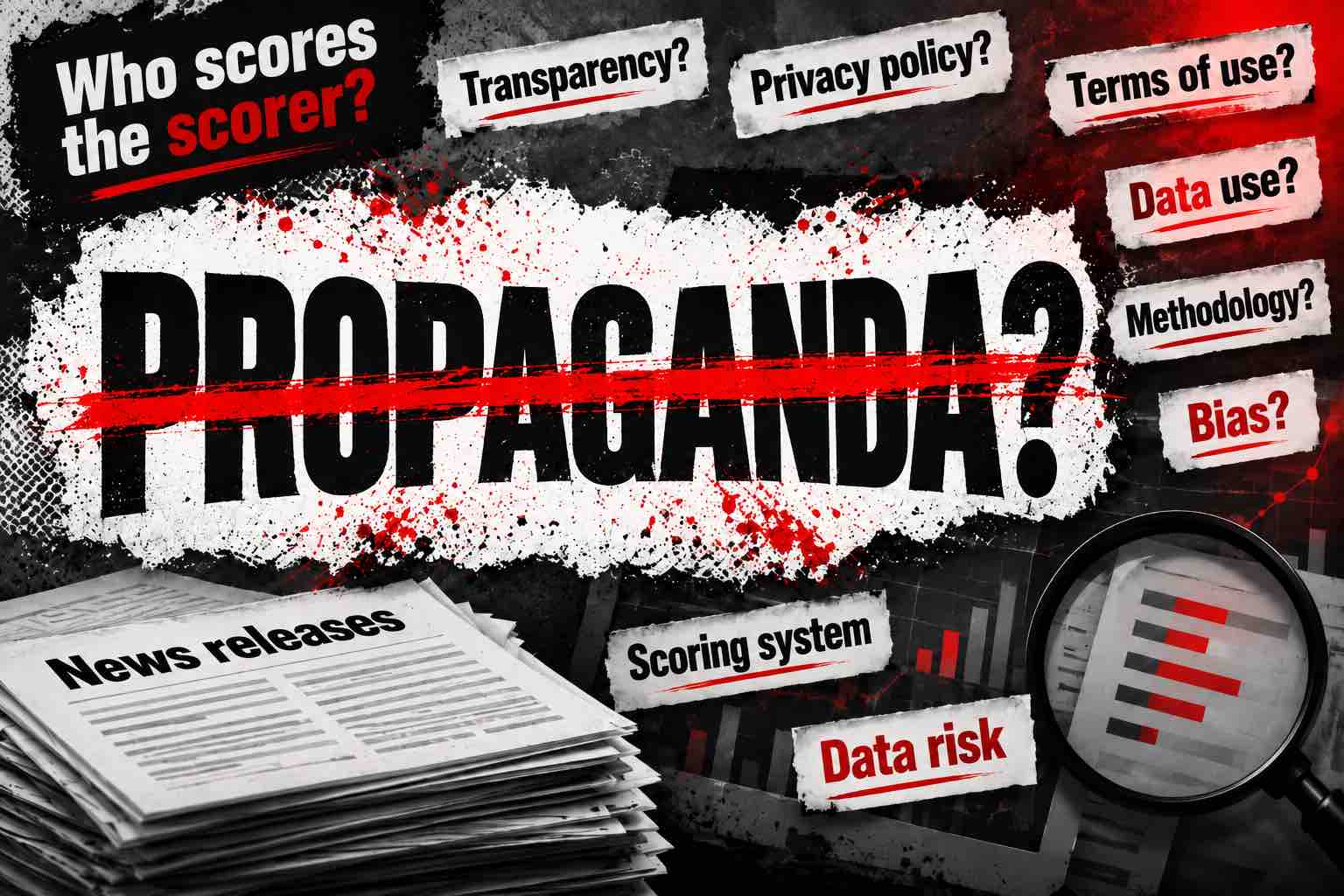
If an app tells you a news release is propaganda, should you trust the score, or should you first ask who is scoring the scorer?
Industry analyst Mike DelPrete recently promoted his new Propaganda.app after using it to score more than 70 real estate press releases for “spin.” His email does not say that he built the app, but in a LinkedIn post, DelPrete says, “I’ve built an app” to identify spin in real estate news and press releases.
His argument is compelling on the surface: Companies use news releases to persuade, journalists sometimes repeat corporate claims without verification and readers should become better at recognizing techniques designed to influence them.
I agree with his premise: readers should be skeptical. Where I disagree is the leap from skepticism to believing an app can objectively determine what constitutes propaganda.
But who scores the scorer?
The bigger question is not whether companies sometimes use persuasive language. Of course they do. The question is whether an automated scoring system or any AI-powered or assisted app, whose methodology is not fully transparent, should be treated as a reliable judge of that language.
I would propose a counterargument.
Before anyone starts using any app to judge communications, we should apply the same level of scrutiny to the scoring system it uses.
What exactly is behind the curtain?
Propaganda says it evaluates releases against seven categories and 22 persuasion patterns, including loaded language, framing, omission, repetition, fear appeals and claims made without evidence. Many of these techniques come from legitimate academic research into persuasion and propaganda, which gives the concept credibility. But that still does not answer the most important question: How does this app turn those concepts into a score?
What model is being used? Is it OpenAI, Anthropic, Google or something else? What instructions has the model been given? How are the categories weighted? Who decided what constitutes a serious violation versus a minor one, and how consistent is the system if the same release is submitted multiple times? Most importantly, has the scoring system itself been independently tested against qualified human reviewers?
Without those answers, citing academic research does not make the score scientific. The research may support the categories the app uses, but it does not prove the scoring system itself is accurate. If we are going to trust the score, we need to understand how the app gets there.
Is AI detecting propaganda or interpreting it?
This gets tricky fast because many of these calls are subjective. Take “loaded language.” Is calling a product “innovative” propaganda, marketing language or an accurate, well-earned reputation in the industry? AI still must make the judgment.
The same is true with omission. A 600-word news release cannot include every fact, every opposing view and every piece of background. Leaving something out does not automatically mean the writer is trying to mislead you.
Framing is also part of almost all communication. Reporters decide what goes in the first paragraph, who gets quoted and what facts matter most. Analysts do the same thing. The real question is not whether framing exists. It is whether the framing is misleading.
A news release is not a newspaper article
One of the biggest claims from this analysis is that 91% of releases include at least one assertion without evidence. That sounds bad until you consider what a news release is supposed to do.
A news release is company communication, not independent journalism. Companies quote their own executives because those executives are explaining the news. Releases also do not usually include an opposing view because that is not their purpose.
And a news release is rarely the entire message. PR professionals also develop a company backgrounder, product backgrounder, fact sheets, FAQs, bios and backgrounders and, of course, the pitch to reporters. In a strong communications program, all those pieces work together. The news release is often just the tip of the messaging, not the whole story, so scoring it in isolation misses the context.
That does not mean companies get a free pass. Facts should be accurate and claims should be supported. But if a scoring system penalizes a release for not looking like a news story, the problem may be with the test, not the release.
Who is fact-checking the fact-checker?
Propaganda makes an important admission: Its score looks at how a release is written, not whether the company is right. That means a completely factual release could still score poorly, while a carefully worded release could sound clean and still be misleading.
This app is not a truth detector. It is a system making judgments about writing style and persuasion. Yes, it may be useful, but it should not be confused with an objective verdict.
What happens to your news release?
There is another issue that concerns me even more: I could not find a privacy policy or terms of use anywhere on the Propaganda.app website. Mike DelPrete says on LinkedIn that he built the app, but I could not find a disclosure on the website identifying the legal entity that owns or operates it or what large language model it uses.
For a tool asking people to paste content into an automated service, that is a serious red flag. Without those disclosures, I have no way of knowing what happens to the information people submit.
Is the content stored? For how long? Is it sent to another AI company? Does that company use the data for training? Can the developer see what you submit? Can your content be used to improve the app? Can you delete it? I could not find answers to any of those questions on the website.
That matters because people may not be submitting information that is already public. What if a company executive pastes in an embargoed news release? What if a public company submits earnings information before it is disclosed? Or a draft announcing an acquisition, lawsuit or other material event? Until Propaganda.app clearly explains how submitted content is handled, I would not put anything into it that is not already public. Or any other app that is not transparent like this one.
The Chrome extension raises another concern because browser extensions can require access to the pages you visit. That does not mean it is unsafe, but you should know exactly what you are giving it access to before installing it on a work browser.
Curiosity is good. Blind trust is not.
I like the idea behind Propaganda because it pushes people to question exaggerated claims, empty buzzwords and weak support. Used the right way, a tool like this could be useful as one more editing check.
I’ve been writing news releases for decades and have written extensively on the use of news releases over the years and the proper etiquette. I even completed a graduate study at USC on trying to figure out what constituted the best news release based on surveys of journalists. So, I absolutely welcome this kind of scrutiny.
But the same standard should apply to the app. If it is going to score companies on transparency and persuasion, it should be transparent about how it works and what happens to the material you give it.
Use it as another set of eyes if you want. Let it flag wording worth another look. Just don’t treat an AI-generated score like an objective ruling. And do not, under any circumstances, put an unpublished news release in any app that is not 100% transparent on its data security, usage and retention rights.
Before we ask AI to score our news releases, perhaps the first thing we should score is the AI.
The post Should you use an app to score a news release? appeared first on WAV Group Consulting.
Leave a Reply