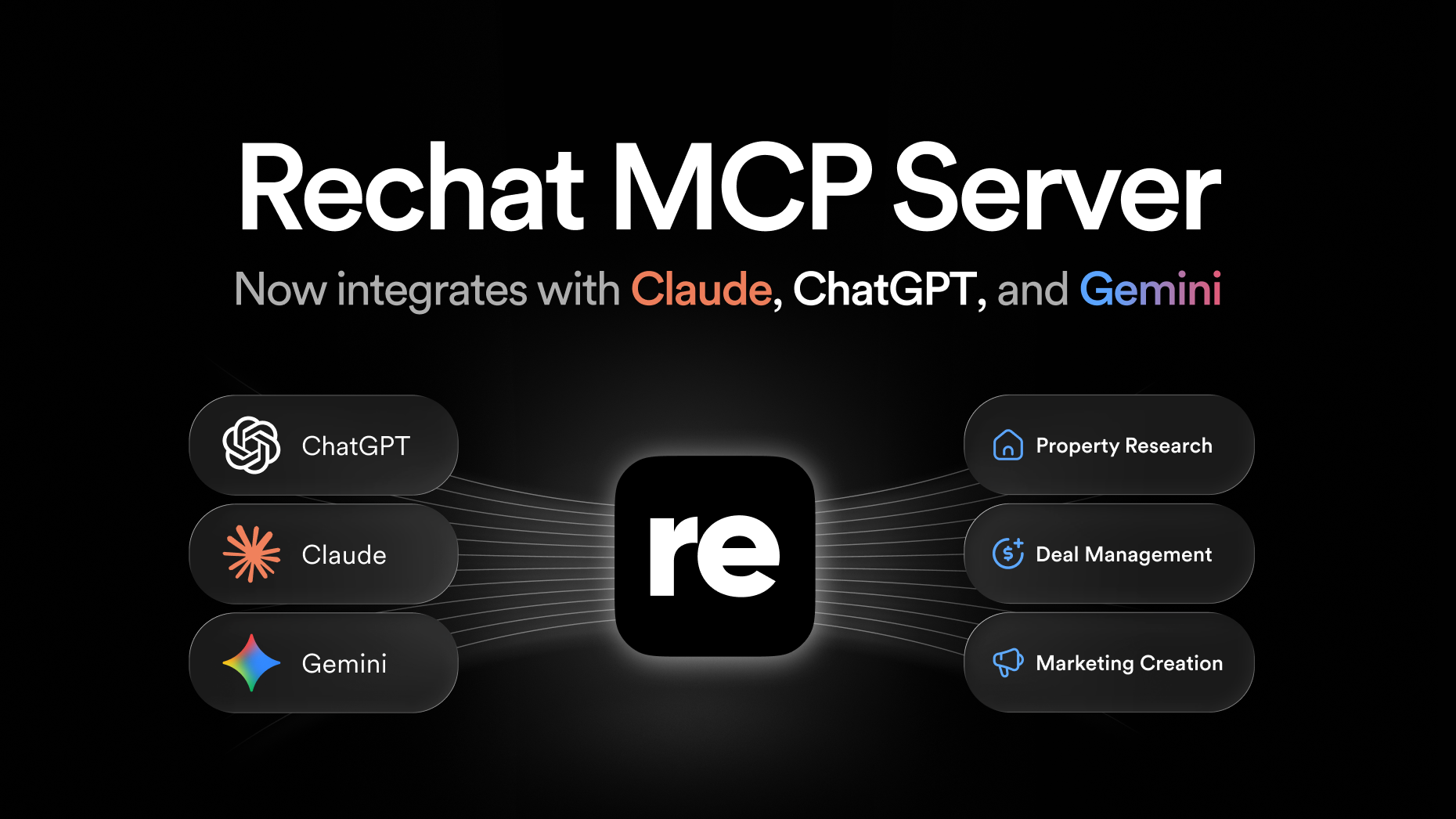
The immediate story is that agents can work inside Rechat from Claude or ChatGPT. The more consequential story is what happens when brokerage, marketing, back-office and MLS systems become available to the same AI assistant.
Rechat has announced the Rechat MCP Server, giving real estate professionals a secure way to access contacts, marketing tools and transaction information through AI assistants such as Anthropic’s Claude and OpenAI’s ChatGPT.

At the agent level, the value proposition is easy to understand. Instead of opening several applications and navigating through their menus, an agent can make a natural-language request:
“Show me the clients I have not contacted in 30 days.”
“Create a follow-up task for everyone who attended Sunday’s open house.”
“Build a social campaign for my new listing.”
“Where does the Johnson transaction stand?”
With the appropriate authorization, the AI assistant can retrieve the necessary information and complete the corresponding work inside Rechat. That is a meaningful improvement over the generic writing and research assistance agents receive from consumer AI tools today. The assistant is no longer simply offering advice; it is acting on the agent’s real contacts, listings, campaigns and transactions.
But that is only the first chapter of this announcement.
The more important development is that Rechat is making its operating system available as part of a much broader agentic technology environment.
(We are hosting a dinner during the RISMedia CEO & Leadership Exchange. We’re gathering on Wednesday evening, September 30th, where you can also meet the Rechat folks. Please email Victor if you would like an invitation–there is limited seating).
Keep reading for a detailed understanding of impact.
MCP Is More Than Another Integration
The Model Context Protocol, or MCP, is an open standard for connecting AI applications to business software and data. An MCP server publishes a defined collection of tools and information that an authorized AI assistant can use.
In practical terms, MCP can do for AI what standardized plugs and ports did for consumer electronics. A software company no longer needs to build a completely different AI integration for every assistant. It can publish an MCP server that compatible AI applications can discover and use.
One of the most important characteristics of MCP is that its servers are designed to be composable.
Composable means that each MCP server can remain focused on what its application does best, while an AI assistant combines the capabilities of several servers to complete a larger assignment.
A CRM server might know how to find contacts and create follow-up tasks. A marketing server might know how to produce a branded campaign. A website server might know how to create a property page. A back-office server might know how to retrieve commission information. An MLS-connected server might provide authorized listing and market data.
Each server supplies a piece of the workflow. The AI assistant assembles those pieces around the agent’s request.
This is similar to building with LEGO blocks. Each block retains its own shape and purpose, but the blocks can be combined into something more useful. A brokerage does not need one enormous application that performs every function. It needs specialized systems that can be securely combined when a workflow requires them.

Technically, the MCP servers do not simply communicate freely with one another. An MCP-compatible host—such as Claude, ChatGPT or a brokerage’s own AI platform—connects to the servers and coordinates the work. The host determines which tools are needed, sends the appropriate request to each server and uses the results to determine the next step.
That distinction is important. Composable does not mean that every connected vendor receives unrestricted access to every other system. Each server can remain isolated, while the AI host manages permissions, user consent and the information required for a particular task. The MCP specification describes this combination of specialization, interoperability and security boundaries as composability.
This is where the Rechat announcement becomes strategically important for brokerages.
Rechat’s server can give an AI assistant access to CRM, marketing and transaction capabilities. A brokerage could also connect that assistant to an MCP server for its website platform, another for accounting or back-office operations, and others for recruiting, training, mortgage, title or insurance services.
The user experiences one assistant. Behind that assistant may be an entire network of securely connected brokerage systems.
From Agent Tasks to Brokerage Workflows
Consider a company such as HomeServices of America. Its enterprise includes brokerage operations along with mortgage, title, escrow, insurance, relocation and other homeownership services. The company describes these businesses as an integrated suite, even though its operating companies retain significant autonomy.
In a traditional software environment, connecting these services requires point-to-point integrations. Each application needs to know which other application it is communicating with, how that system organizes its data and what its API allows.
MCP introduces a different model. Each system can describe its capabilities in a form an AI assistant understands. The assistant can then select and sequence those capabilities into a workflow.
Imagine an agent asking:
“Prepare me for my listing appointment with the Smiths tomorrow.”
An agentic workflow could potentially:
- Retrieve the Smith contact history and relationship notes from the CRM.
- Review the appointment and prior communications.
- Pull current and historical property information.
- Assemble relevant comparable sales.
- Create a branded presentation using the brokerage’s marketing system.
- Check the property website platform for available domains or templates.
- Prepare the required brokerage forms.
- Create a task plan for photography, staging and launch.
- Identify relevant mortgage, title or insurance resources for the client.
Today, those steps may require several systems, multiple logins and a significant amount of copying and pasting. In an MCP-enabled environment, one assistant could coordinate the work across the authorized systems.
That is a much bigger idea than “Rechat integrates with Claude.”
It is the beginning of a brokerage service layer that can be activated through conversation.
Completing the Circle With MLS Data
There is still one essential ingredient: trusted property and market data.
Rechat can provide information about the agent’s relationships, marketing and transactions. Brokerage systems can provide websites, accounting, compliance and affiliated services. An MLS connection can supply the authoritative listing and market information needed to ground those workflows in real estate data.
An initiative such as Project NexusRE could help complete that circle by providing a governed connection to broker- and MLS-controlled listing data. NexusRE is particularly relevant because its stated purpose goes beyond making data available. It is focused on preserving industry governance over how listing data is accessed and used by AI.
With that connection in place, an assistant could move across the complete professional workflow:
MLS data → CRM intelligence → brokerage services → marketing execution → transaction management → back-office operations
For example, an agent could ask:
“Find the homeowners in my database who may be a fit for the new listing on Oak Street, explain why they are a match, and prepare a compliant outreach campaign.”
The assistant might use MLS information to understand the property, Rechat to identify appropriate contacts, the brokerage’s marketing system to create approved materials and the agent’s communication tools to prepare the outreach. Permissions and human approvals could be applied at every significant step.
This is composability in action. No single server needs to perform the entire assignment. Each connected system contributes its specialized capability, while the AI assistant coordinates the steps and presents the agent with a unified result.
The value does not come from any one system. It comes from the assistant’s ability to coordinate several systems around an outcome.
The Brokerage Becomes the Orchestrator
This evolution should get the attention of every brokerage technology leader.
For years, brokerages have tried to solve fragmentation by putting more features into a single platform or creating a single sign-on dashboard. Those approaches can improve access, but they do not necessarily create interoperability. Agents may have fewer passwords while still moving data manually from one application to another.
Agentic workflows change the objective.
The goal is no longer simply to put every tool on one screen. The goal is to make the brokerage’s tools, data and services understandable and actionable to an authorized AI assistant.
This gives large brokerages an opportunity to reclaim an important role in the technology experience. Rather than letting a general-purpose AI platform determine how the agent’s business operates, the brokerage can establish which systems are available, what data may be used and which actions require approval.
That governance will be essential. MCP makes software more accessible to AI, but it does not eliminate the need for identity management, data licensing, audit logs, compliance controls and human oversight. Brokerages will need policies governing which assistants may connect, what tools may be invoked and when an agent or manager must confirm an action.
Rechat says its server uses OAuth and applies the permissions of the individual user. That is the correct foundation. The AI assistant should never have broader authority than the professional it represents.
A New Standard for Brokerage Technology
Rechat’s announcement is significant because it moves MCP into the professional operating core of real estate.
The first benefits will be relatively straightforward: updating contacts, creating tasks, launching marketing and checking deal status from an AI assistant. These capabilities can save agents time and increase adoption of the brokerage’s existing technology.
The larger opportunity is cross-platform orchestration.
When CRM and marketing systems, brokerage websites, transaction platforms, back-office tools and governed MLS data can all be accessed through a common protocol, the industry can begin replacing fragmented application workflows with coordinated agentic services.
Rechat has opened an important door. The next step is for brokerage technology providers, MLS organizations and enterprise real estate companies to walk through it together.
The winners will not necessarily be the companies with the biggest standalone application. They will be the companies that make their data and capabilities securely available within a trusted, brokerage-controlled AI ecosystem.
That is the real significance of the Rechat MCP Server. It does not merely bring Rechat into Claude or ChatGPT. It creates the possibility that an agent’s entire business—and eventually the brokerage’s complete service platform—can work together through one intelligent interface.
The post Rechat’s MCP Server Points to a Connected, Agentic Future for Real Estate appeared first on WAV Group Consulting.
Leave a Reply